
10sec
Auto-calibration
Each time we detect your body
BodySignals tracks how you sit, walk and move, alerts you when to adjust or take a break, and shows which habits make a difference.
Free to start · Works with AirPods Pro, AirPods (3rd gen and later) and AirPods Max
Coming soon to iPhone. One email on launch day, nothing else · Works with AirPods Pro, AirPods (3rd gen and later) and AirPods Max
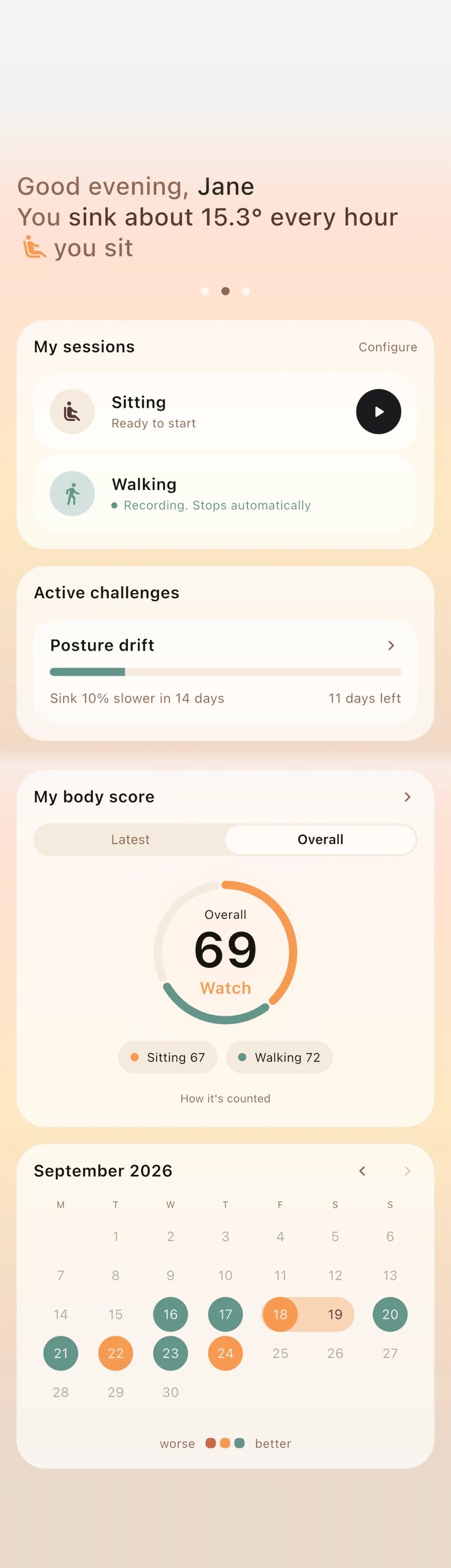
Every routine shapes how you sit, walk and move, from text neck to a stiff back after a long drive. BodySignals learns your patterns and shows you what to change.
BodySignals combines data from your everyday movement with carefully validated signals to help you understand what’s happening, and what you can do about it.
Each time we detect your body
Every degree of drift, as it happens
Starts when you do and stops itself
Knows when you’re getting tired
One quiet nudge, at your line
Your head sits 12° forward of your upright, mostly after 15:00. The further forward it goes, the harder your neck works.
Not just a score
A single sitting tells you little. Sixty days tell you when, where and for how long you lose your posture, and whether the change you made is working. Why sitting posture drifts over the day.
Walks and daily posture go into Apple Health, so they sit beside your steps, sleep and heart rate — and stay yours if you ever leave.
Tracking is free and stays free. Premium adds the history and analysis that turn a good week into a habit.
Fresh studies on posture, sitting and movement, and what they mean for you, alongside guides from the BodySignals Library.
In 313 students, neck trouble was more common in those with a head down phone posture and heavy phone use.
PeerJ, 2022 6 Oct 2026In a lab study, 20 adults sat at a computer for two hours. Discomfort rose everywhere, most in the lower back and hips.
International Journal of Environmental Research and Public Health, 2018 PostureHow to improve posture with what research supports: move often, train endurance, set up your screens and skip the gadgets. A practical plan with sources.
Read more in Library SittingDoes exercise cancel out a day of sitting? What a meta-analysis of over a million people found, what sitting does to your back, and why breaks still matter.
Read more in LibraryAirPods Pro, AirPods 3rd generation and later, and AirPods Max. They need head tracking, and they need to be in your ears.
Yes. AirPods with head tracking report how your head moves and tilts. BodySignals reads that motion while you sit and walk, learns your own upright and measures how far and how long you drift from it. How posture tracking with AirPods works.
No. It doesn't hold you in place. It is a posture tracker: it measures how you sit and walk and gives you a quiet nudge when you slouch for a while. Straps and braces have little evidence for lasting change, see what the research says about posture correctors.
No. A walk starts on its own after ten seconds of walking, and a sitting ends when you stand up. You can still start one yourself.
Only as much as you ask it to. Choose precise, calm or off. Calm reminds you at most every 15 minutes, and nothing comes before a full minute past your own line.
It learns your upright in the first ten seconds of each session, so a new chair or a laptop on the sofa doesn't throw it off.
No. BodySignals reads the motion sensors only while a session is running and lets go of them the moment it ends, so your AirPods and iPhone last as long as they always do.
Your sessions, scores and insights stay on your iPhone. No account, no ads, and we never sell data.
Sitting and walking sessions, the Body score and calendar, your current insight and slouch notifications. Premium adds long-term history, deeper insights, challenges and Apple Health.
BodySignals learns how you sit, walk and move, then helps you understand what to change.